Sep 13, 2017

Chamarel Seven Coloured Earth, Rivière Noire District, Mauritius

The Seven Coloured Earths are a geological formation and prominent tourist attraction found in the Chamarel plain of the Rivière Noire District in south-western Mauritius. It is a relatively small area of sand dunes comprising sand of seven distinct colours (approximately red, brown, violet, green, blue, purple and yellow). The main feature of the place is that since these differently coloured sands spontaneously settle in different layers, dunes acquire a surrealistic, striped colouring. Another interesting feature of Chamarel's Coloured Earths is that the dunes seemingly never erode, in spite of Mauritius' torrential tropical rains.

The “seven-coloured earth” of Chamarel is a geological curiosity and a major tourist attraction of Mauritius. This is a small (7500 m2) area of strikingly bare landscape located within a large, dense forest. The earth is particularly unusual; created by volcanic rocks that cooled at different temperatures, the earth form beautiful patterns of colour in the exposed hillsides. The rocks were pulverized into sands with various shades of red, brown, grey, and purple. Since the earth was first exposed, rains had carved beautiful patterns of many colours into the hillside. When visiting the park, you will be able to walk between the many sand dunes, along trails and see this unique sight. Also, there is a small petting farm where you can see and pet Giant Turtles which found their home at the park.


Since the earth was first exposed, rains had carved beautiful patterns into the hillside, creating an effect of earthen meringue. At first you'll notice shadows on the hills, creating the illusion of different colours, but soon you realise that the colours are real and the shadows were the illusion.

Sunrise is the best time to see the Coloured Earths. Geologists are still intrigued by the rolling dunes of multi-coloured lunar-like landscape. The colours, red, brown, violet, green, blue, purple and yellow never erode in spite of torrential downpours and adverse climatic conditions.

The Colored Earth of Chamarel has become one of Mauritius' main tourist attractions since the 1960s. Nowadays, the dunes are protected by a wooden fence and visitors are not allowed to climb on them, although they can look at the scenery from observation outposts placed along the fence. Curio shops in the area sell small test-tubes filled up with the coloured earths.

Aug 28, 2017

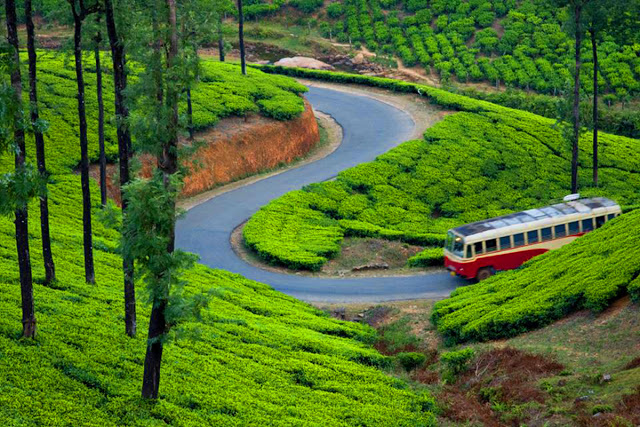
Munnar (The Kashmir of South India), Kerala, India

Munnar  is a town and hill station located in the Idukki district of the southwestern Indian state of Kerala. Munnar is situated at around 1,600 metres (5,200 ft) above mean sea level, in the Western Ghats range of mountain. Munnar is an idyllic hill station, famous for its tea estates, exotic scenery, abundance of flora and fauna and craggy peaks.

One of the biggest tea-plantation area of South India, Munnar is one of the most beautiful and popular hill-stations of Kerala. Situated on the
three mountain streams merge - Mudrapuzha, Nallathanni and Kundala. 1,600 m above sea level, this hill station was once the summer resort of the erstwhile British Government in South India blessed with natural view-points apart from the tea-plantations. Munnar is divided into Old Munnar, where the tourist information office is, and Munnar, where the bus station and most guest houses are located. The Eravikulam National Park, Salim Ali Bird Sanctuary and tea plantations are its major attractions.


Sprawling tea plantations, picturesque towns, winding lanes and holiday facilities make this a popular resort town. Among the exotic flora found in the forests and grasslands here is the Neelakurinji. This flower which bathes the hills in blue once in every twelve years, will bloom next in 2018. Munnar also has the highest peak in South India, Anamudi, which towers over 2,695 m. Anamudi is an ideal spot for trekking.

Eravikulam National Park

One of the main attractions near Munnar is the Eravikulam National Park. This park is famous for its endangered inhabitant - the Nilgiri Tahr. Spread over an area of 97 sq. km., this park is also home to several species of rare butterflies, animals and birds. A great place for trekking, the park offers a magnificent view of the tea plantations caressed by blankets of mists. The park becomes a hot destination when the hill slopes here get covered in a carpet of blue, resulting from the flowering of the Neelakurinji. It is a plant endemic to this part of the Western Ghats which blooms once in twelve years.

Anamudi Peak

Located inside the Eravikulam National Park is the Anamudi Peak. This is the highest peak in South India, standing at a height of over 2700 m. Treks to the peak are allowed with permission from the Forest and Wildlife authorities at Eravikulam.

Mattupetty

Another prime draw for visitors, located about 13 km from Munnar Town, is Mattupetty. Situated at a height of 1700 m above sea level, Mattupetty is known for its storage masonry dam and the beautiful lake, which offers pleasurable boat rides, enabling one to enjoy the surrounding hills and landscape. Mattupetty's fame is also attributed to the dairy farm run by the Indo-Swiss Livestock Project, where one can encounter different high yielding breeds of cows.

Pallivasal

Pallivasal, located at about 3 km from Chithirapuram in Munnar is the venue of the first hydro-electric project in Kerala. It is a place of immense scenic beauty and is often favoured by visitors as a picnic spot.

Chinnakanal & Anayirangal

Near Munnar Town lie Chinnakanal and its waterfalls, popularly known as the Power House Waterfalls, which cascade down a steep rock 2000 m above sea level. The spot is enriched with a scenic view of the Western Ghat ranges. When you have traveled about seven kilometers from Chinnakanal, you reach Anayirangal. Anayirangal, 22 km from Munnar, is a lush green carpet of tea plants. A trip on the splendid reservoir is an unforgettable experience. The Anayirangal dam is surrounded by tea plantations and evergreen forests.

Top Station

Top Station, which is about 32 km from Munnar is at a height of 1700 m above sea level. It is the highest point on the Munnar-Kodaikanal road. Travellers to Munnar make it a point to visit Top Station to enjoy the panoramic view it offers of the neighbouring state of Tamil Nadu. It is among the prime spots in Munnar to enjoy the Neelakurinji flowers blooming over a vast area.

Tea Museum

Munnar has a legacy of its own when it comes to the origins and evolution of tea plantations. Taking account of this legacy and to preserve and showcase some of the exquisite and interesting aspects of the genesis and growth of tea plantations in Kerala's high ranges, a museum exclusively for tea was opened some years ago by Tata Tea in Munnar. This Tea Museum houses artifacts, photographs and machinery; all of which have a story to tell about the origins and growth of tea plantations in Munnar. The museum is located at the Nallathanni Estate of Tata Tea in Munnar and is worth a visit.

Jun 24, 2017

Son Bhandar Caves (Cave Of lost Gold), Rajgir, Bihar State, India

Son Bhandar Caves situated at Rajgir, Nalanda in Bihar state. Son bhandar group of caves has two caves known as eastern and western cave. Son bhandar caves are concerned with Jainism and considered to belong to 3-4 century AD. These caves were first inspected by cunninghum and he concluded to have analogy with saptparni caves of Buddhism creed. After cunninghum several scholars visited this place and some had opinion to concern with Buddhism. After some time all Buddhism connections were refused because of an inscription found on the southern wall of a cave. According to this inscription these caves were built by inspiration of a Jain muni Vair for Jain ascetics. Sculptures of Teerthankaras were also carved in these caves. From architectural aspect; these caves are analogous to Nagarjuni cave and Barbar caves of Mauryan era. Therefore it can be concluded that construction time should not be much differ from above mentioned caves. These caves should be related to digambar sect of Jainism as Xuanzang wrote in his book about Vaibhar hill of rajgir that the place was occupied by Digambar Jaina monks for meditation purpose. After some centuries these caves were converted by Hindus as Lord Vishnu sculpture was also found from mound of a cave. 


It is the western cave which gave the name to monument: Son Bhandar means "store of gold" and legend about this treasure is linked to western cave.

The cave believed to be a guard cave – contains single rectangular chamber, 10.4 x 5.2 m large. The vaulted ceiling stands stands on vertical walls, vault rises up to 1.5 m high. This resembles the style of older Mauryan rock-cut sanctuaries. In ancient times most likely there was a roofed verandah in the front of caves.

Walls, doorjambs and front wall contains numerous epigraphs. Small image of standing Vishnu is etched on the left side of doorway this possibly testifies that caves were taken over for Hindu worship. Local legend tells that the this cave still hides a passage to the treasury of gold entrance in this passage is well hidden in the cave chamber behind an ancient stone wedge. Some also believe that the passage goes through Vaibhargiri mountain and reaches Saptaparni Caves on the other side of range. Some believe that this treasure belongs to Jarasandha, others that to Bimbisara. In a case of Bimbisara legend goes that when Ajatashatru confined his father Bimbisara (remnants of this prison are nearby), his mother secretly hid some wealth and later donated it to Tirthankar.

In the wall of cave there is seen a trace of carving, resembling a doorway and next to it – an undeciphered inscription in Sankhlipi writing or shell script. It is believed that this inscription is a password who will read it, will open the door and enter the passage. This ornate script has been found in India as well as in Java and Borneo and never been deciphered. There is also a black mark above or in the upper part of the mysterious doorway is of left by cannonball when Brits tried (without success) to break the wall and enter the passage. 

Eastern cave is partly ruined – front part of cave chamber has fallen. Upper floor above the cliff made in brick is added later, during Gupta period and possibly caused the collapse of front wall of the cave. Most likely also this cave had verandah in front. Southern wall of this cave contains important early Jain artwork – exquisitely sculpted small reliefs of six Jain Tirthankaras – Padmaprabh, Parsvanath, Mahavira and others. This relief seems to be added later, some time after the completion of caves, it shows little congruity with the plan of rock-chamber.

May 9, 2017

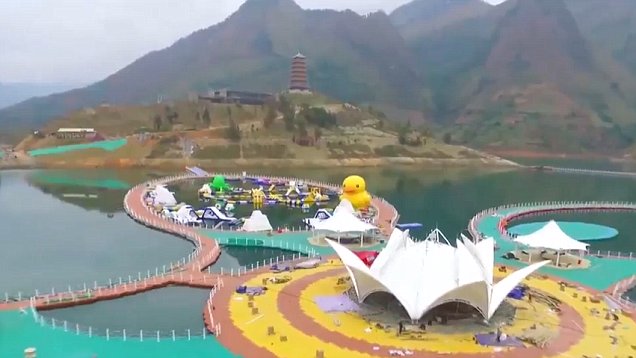
A Bird's-Eye View of The Floating Walkway, Luodian County, China

A bird's-eye view of the floating walkway structure built atop the Hongshui River in the Luodian County of southwest China.
 
According to China Xinhua News, a floating walkway which stretches a staggering 31 miles has been built atop the Hongshui River in the Luodian County of southwest China. The new tourist attraction is said to have opened on New Year’s Day and has already been visited by over 60,000 tourists.


The walkway is reportedly kept afloat by over 200,000 floating objects, which include a massive cartoon duck right in the middle of it all. During the day, visitors can partake in water sports, such as jet skiing or soaring around the river in water-powered jetpacks. At night, thousands of colored lights illuminate the walkway, giving it a festive air.

China’s new attraction mimics last year’s floating walkway installation in Italy. The walkway, which was set atop Lake Iseo in Northern Italy, was only at the site for three weeks, according to Bored Panda. However, the 2-mile walkway made up of 200,000 high-density polyethylene cubes covered in yellow fabric enchanted visitors as it changed colors when wet.

The walkway in Italy was the brainchild of artist Christo and his late wife, Jeanne-Claude. The artists reportedly did not charge an admission fee for guests to walk the massive installation, as they aimed to create works of art for the public to enjoy free of charge.

Apr 15, 2017

Sigiriya: The Majestic Rock Fortress of Sri Lanka

Sigiriya, or the "Lion Rock", is not just an architectural marvel but also a masterpiece of ingenuity, artistry, and cultural legacy. Rising majestically from the central plains of Sri Lanka, this awe-inspiring rock fortress is a symbol of Sri Lanka's golden age of civilization. Declared a UNESCO World Heritage Site in 1982, Sigiriya attracts thousands of visitors each year, drawn by its remarkable history, stunning frescoes, and breathtaking views.

Sigiriya
 
Sigiriya consists of an ancient citadel built by King Kashyapa during the 5th century. The Sigiriya site contains the ruins of an upper palace located on the flat top of the rock, a mid-level terrace that includes the Lion Gate and the mirror wall with its frescoes, the lower palaces located behind the lavish lower gardens, and moats and ramparts which protected the citadel. The site was both a palace and a fortress. The upper palace on the top of the rock includes cisterns cut into the rock. The moats and walls that surround the lower palace are exquisitely beautiful.

The environment around the Sigiriya may have been inhabited since prehistoric times. There is clear evidence that the many rock shelters and caves in the vicinity were occupied by Buddhist monks and ascetics from as early as the 3rd century BCE. The earliest evidence of human habitation at Sigiriya is the Aligala rock shelter to the east of Sigiriya rock, indicating that the area was occupied nearly five thousand years ago during the Mesolithic Period.
 
Sigiriya

Historical Background of Sigiriya

1. The Tale of King Kashyapa

The story of Sigiriya begins with King Kashyapa I (477–495 CE), an ambitious and controversial ruler. Kashyapa, the son of King Dhatusena, seized the throne through a dramatic coup, overthrowing and reportedly executing his father. This act earned him the wrath of his half-brother, Prince Moggallana, who fled to India to prepare for revenge.

Fearing retaliation, Kashyapa relocated the capital from Anuradhapura to Sigiriya, a naturally defensible location. He transformed this colossal granite rock into a magnificent fortress city, combining military strategy with opulent luxury. However, Kashyapa's reign ended tragically when he was defeated in battle by Moggallana. Following his death, Sigiriya was abandoned as a royal capital and later became a Buddhist monastery.

2. Buddhist Monastic Period

For several centuries after Kashyapa’s fall, Sigiriya served as a monastery. The site’s tranquil surroundings and spiritual aura attracted Buddhist monks, who used it for meditation and religious activities. This phase lasted until the 14th century, after which the site fell into disuse.

Sigiriya

3. Rediscovery by the British

In the 19th century, Sigiriya was rediscovered by British archaeologists, including H.C.P. Bell, who conducted extensive studies and excavations. Their work revealed the site's rich history and grandeur, catapulting it to global prominence.

The Architecture of Sigiriya

Sigiriya is celebrated for its ingenious blend of nature and architecture, seamlessly integrating the rock’s natural formations into its design. The site reflects advanced urban planning, featuring symmetrical layouts, sophisticated hydraulics, and innovative defensive mechanisms.

1. The Outer City and Moats

The outermost area of Sigiriya includes wide moats and ramparts that provided a first line of defense. The moats were filled with water and, according to legend, crocodiles. These features highlight the strategic importance of Sigiriya as a fortress.

2. The Water Gardens

The lower part of Sigiriya is adorned with a network of water gardens, which are among the oldest landscaped gardens in the world. The gardens include:

  • Symmetrical Pools: Arranged in a geometric layout, some of these pools were likely used for bathing or decorative purposes.
  • Fountains: Ingeniously designed fountains fed by underground water channels, still operational during the rainy season.
  • Pavilions and Pathways: Elegant walkways connected the gardens, creating an atmosphere of luxury and leisure.

3. The Boulder Gardens

As visitors ascend, they encounter the Boulder Gardens, a series of natural rock formations transformed into a meditative space. The pathways wind around massive boulders, some of which were carved into shelters or used as viewing platforms.

Sigiriya

4. The Lion’s Gate

The most iconic feature of Sigiriya is the Lion’s Gate, located midway up the rock. The gate consisted of a massive lion-shaped structure with a head and forelegs. Visitors entered the fortress through the lion's mouth. While the head no longer exists, the colossal lion’s paws remain, serving as a dramatic reminder of its former grandeur.

5. The Summit

The summit of Sigiriya spans approximately 1.6 hectares (4 acres) and housed the royal palace. The ruins of this palace include:

  • A large swimming pool, likely used for leisure and ceremonial purposes.
  • Audience halls and living quarters, strategically placed to enjoy panoramic views.
  • Gardens and terraces, blending natural rock formations with man-made features.

The Frescoes: Sigiriya’s Artistic Legacy

Sigiriya is famous for its frescoes, located in a sheltered gallery on the western rock face. These paintings are believed to depict celestial maidens (Apsaras) or women from Kashyapa's court. Key features of the frescoes include:

  • Vivid Colors: Despite being over 1,500 years old, the frescoes retain their brilliance, showcasing reds, greens, and golds.
  • Realistic Details: The figures are depicted with graceful curves, intricate jewelry, and lifelike expressions.
  • Symbolism: Scholars debate whether the frescoes represent goddesses, queens, or attendants, but their beauty is universally admired.

The Mirror Wall: Ancient Graffiti

The Mirror Wall, originally polished to a mirror-like finish, reflected the images of those walking by. Over time, it became a surface for graffiti, inscribed by visitors over the centuries. These inscriptions, written in ancient Sinhala script, include:

  • Poems celebrating the beauty of the frescoes.
  • Expressions of wonder at Sigiriya’s splendor.
  • Historical records, providing insights into medieval Sri Lankan society.
The Sri Lankan archaeologist Dr Senerat Paranavitana deciphered 685 verses written in the 8th, 9th and 10th centuries CE on the mirror wall. One such poem from these long-past centuries, roughly translated from Sinhala, is:

    "I am Budal [the writer's name]. Came with hundreds of people tо see Sigiriya. Since аll the others wrote poems, I did not!"  

Sigiriya

Engineering Feats at Sigiriya

One of the most remarkable aspects of Sigiriya is its advanced engineering:

  • Hydraulic Systems: Underground conduits, cisterns, and pumps ensured a steady water supply to the gardens and summit.
  • Drainage Systems: Ingenious drainage channels prevented erosion, preserving the rock over centuries.
  • Wind and Temperature Regulation: The placement of gardens and pavilions maximized natural ventilation, maintaining a comfortable climate.

The Cultural and Symbolic Role of Sigiriya

Sigiriya’s design reflects not only practical concerns but also deep symbolic meanings. The site is often interpreted as a recreation of Alakamanda, the mythical city of the gods in Buddhist cosmology. The central rock may have symbolized Mount Meru, the axis of the universe in Hindu and Buddhist traditions.

Visiting Sigiriya: Practical Information

  • Entry Fees: $30 for foreign nationals; reduced rates for SAARC citizens.
  • Climbing Difficulty: Moderate; the climb involves approximately 1,200 steps but is manageable for most visitors with breaks.
  • Nearby Attractions:
    • Pidurangala Rock: An alternative climb with stunning views of Sigiriya.
    • Dambulla Cave Temple: A nearby UNESCO site with ancient Buddhist murals.
    • Minneriya National Park: Famous for its elephant gatherings.

Travel Tips for Sigiriya

  1. Best Time to Visit: The ideal months are December to April, when the weather is dry and pleasant.
  2. Time of Day: Start early in the morning to avoid crowds and the midday heat.
  3. What to Bring: Comfortable walking shoes, water, sunscreen, and a hat.
  4. Nearby Attractions:
    • Pidurangala Rock: A nearby rock formation offering stunning views of Sigiriya.
    • Dambulla Cave Temple: A Buddhist temple complex with ancient murals and statues.
Why Sigiriya Matters Today

Sigiriya is more than an ancient relic; it is a testament to human creativity and resilience. It offers a window into the ingenuity of Sri Lanka’s ancient civilizations and continues to inspire awe among visitors. As a symbol of the island’s rich heritage, Sigiriya embodies the harmony between man, nature, and art.

Sigiriya

Conclusion

Sigiriya is more than just a historic site; it is a testament to the creativity, resilience, and cultural richness of ancient Sri Lanka. Whether you're an art lover, history buff, or adventurous traveler, Sigiriya promises an unforgettable journey through time and a chance to witness one of the world's most remarkable ancient wonders.

Sigiriya

Sigiriya

Sigiriya

Sigiriya

Sigiriya

Sigiriya

Sigiriya

Sigiriya

Sigiriya

Sigiriya

Sigiriya