Feb 4, 2019

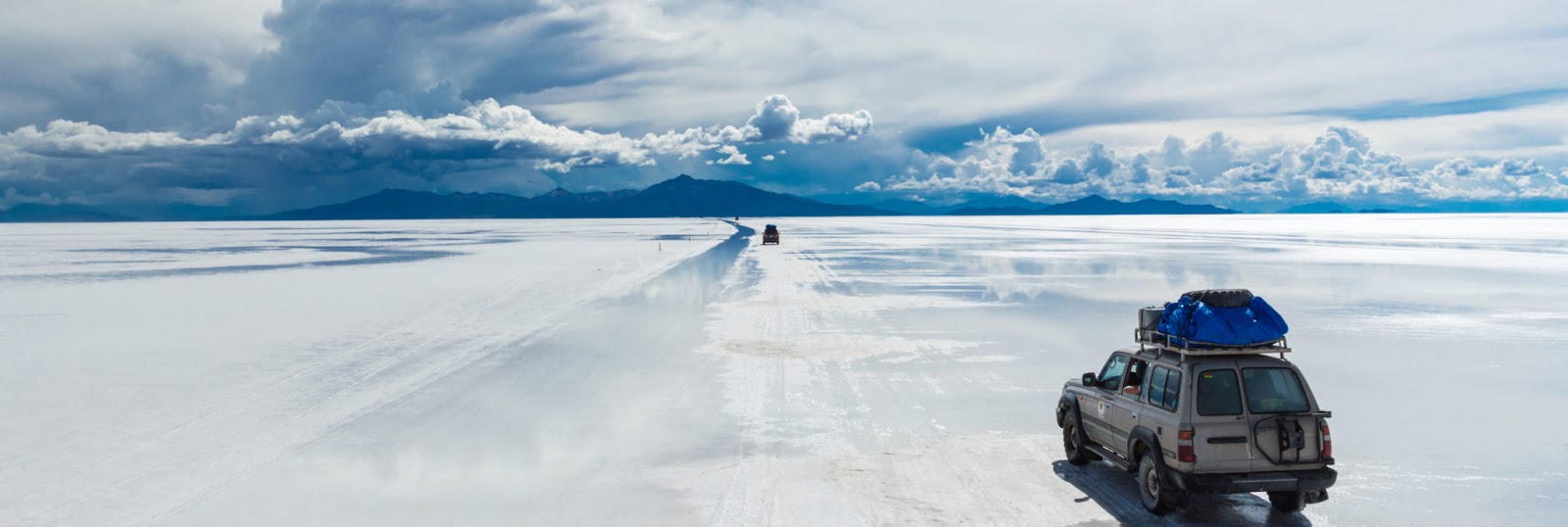
Salar de Uyuni (World's Largest Mirror), Andes in Southwest Bolivia

Salar de Uyuni or Salar de Tunupa is the world's largest salt flat, at 10,582 square kilometers (4,086 sq mi). It is in the Daniel Campos Province in Potosí in southwest Bolivia, near the crest of the Andes and is at an elevation of 3,656 meters (11,995 ft) above sea level.

The Salar was formed as a result of transformations between several prehistoric lakes. It is covered by a few meters of salt crust, which has an extraordinary flatness with the average elevation variations within one meter over the entire area of the Salar. The crust serves as a source of salt and covers a pool of brine, which is exceptionally rich in lithium. It contains 50% to 70% of the world's known lithium reserves. The large area, clear skies, and exceptional flatness of the surface make the Salar an ideal object for calibrating the altimeters of Earth observation satellites. Following rain, a thin layer of dead calm water transforms the flat into the world's largest mirror, 129 kilometers (80 miles) across. 

The Salar serves as the major transport route across the Bolivian Altiplano and is a major breeding ground for several species of flamingos. Salar de Uyuni is also a climatologist transitional zone since the towering tropical cumulus congest us and cumulonimbus incus clouds that form in the eastern part of the salt flat during the summer cannot permeate beyond its drier western edges, near the Chilean border and the Atacama Desert.
 
Salar is salt flat in Spanish. Uyuni originates from the Aymara language and means a pen (enclosure); Uyuni is a surname and the name of a town that serves as a gateway for tourists visiting the Salar. Thus Salar de Uyuni can be loosely translated as a salt flat with enclosures, the latter possibly referring to the "islands" of the Salar; or as "salt-flat at Uyuni


Salar de Uyuni is part of the Altiplano of Bolivia in South America. The Altiplano is a high plateau, which was formed during uplift of the Andes mountains. The plateau includes fresh and saltwater lakes as well as salt flats and is surrounded by mountains with no drainage outlets. The Salar contains a large amount of sodium, potassium, lithium and magnesium as well as borax. Of those, lithium is arguably most important as it is a vital component of many electric batteries. With estimated 9,000,000. The Bolivia holds about 43 % of the world's known lithium reserves; most of those are in the Salar de Uyuni

The area has a relatively stable average temperature with a peak at 21 °C in November to January and a low of 13 °C in June. The nights are cold all through the year, with temperatures between −9 °C and 5 °C. The relative humidity is rather low and constant throughout the year at 30% to 45%. The rainfall is also low at 1 mm to 3 mm per month between April and November, but it may increase up to 80 mm in January. However, except for January, even in the rainy season the number of rainy days is fewer than 5 per month and Every November, Salar de Uyuni is the breeding ground for three species of pink South American flamingo: the Chilean, Andean, and rare James's flamingos, their color presumably originating from feeding on pink algae. About 80 other bird species are present, including the horned coot, Andean goose, and Andean hillstar. The Andean fox, or culpeo, is also present, and islands in the Salar host colonies of rabbit-like viscachas

Salar de Uyuni attracts tourists from around the world. As it is far from the cities, a number of hotels have been built in the area. Due to lack of conventional construction materials, many of them are almost entirely (walls, roof, furniture) built with salt blocks cut from the Salar. The first such hotel, named Palacio de Sal, was erected in 1993–1995 in the middle of the salt flat, and soon became a popular tourist destination. However, its location in the center of a desert caused sanitation problems, as most waste had to be collected manually. Mismanagement caused serious environmental pollution and the hotel had to be dismantled in 2002. One major tourist attraction is an antique train cemetery. It is 3 km outside Uyuni and is connected to it by the old train tracks. The town served in the past as a distribution hub for the trains carrying minerals en route to Pacific Ocean ports. The rail lines were built by British engineers arriving near the end of the 19th century and formed a sizeable community in Uyuni. The engineers were invited by the British-sponsored Antofagasta and Bolivia Railway Companies, now Ferrocarril de Antofagasta a Bolivia. The rail construction started in 1888 and ended in 1892. It was encouraged by Bolivian President Aniceto Arce, who believed Bolivia would flourish with a good transport system, but it was also constantly sabotaged by the local Aymara indigenous Indians who saw it as an intrusion into their lives. The trains were mostly used by the mining companies. In the 1940s, the mining industry collapsed, partly because of mineral depletion. Many trains were abandoned, producing the train cemetery. There are proposals to build a museum from the cemetery.

Feb 3, 2019

The Marble Caves of Chile (Unique Places of the World), Chile Chico, Chile

The Marble Caves of Chile are sometimes called “the Marble Caverns,” “the Marble Cathedral,” or “the Marble Chapel.” Care should be used when using these other names because they may refer to other specific features within the marble caves. In the native tongue, the caves are known as “Cuevas de Mármol.”  

Aggressive waves have washed up against the marble (calcium carbonate) for years, and slowly shaped the curved walls. However, these strong walls of marble cave in Patagonia did not instantly mold into the unique structure you see today. This process has been occurring for over six centuries! Its smooth and vibrant walls are now a reflection of the lake’s azure waters, which often change in color depending on the water levels and time of year.

The caves are situated in the Patagonian Andes. More specifically, the Marble Caves are sitting on a peninsula of marble that borders Lake General Carrera (as it is called in Chile). The lake is shared by Chile and Argentina and is known as Lake Buenos Aires on the Argentinian side.


The uniqueness of the caves ranges from its formation to the spectacular beauty that it is today. The beauty that is found there has taken over 6,000 years. Furthermore, the caves glow a range of magical colors depending on the level of the water. The stones themselves do not glow. Instead, the water reflects a range of cerulean hues and intensities that create a magical and tantalizing effect. During spring, the shallow levels of water reflect a turquoise hue on the caves. The high levels of water during the summer brought about by glacial melting provide a deep cerulean blue hue. At times, the reflections may also be white, grey, or the occasional pink. While they may seem ordinary on the outside, they are anything but. The biggest threat to the caves is the water. The erosion that has shaped the caves may very well be its undoing in the future. The reason for this is because the erosion caused by the wave action is unchecked. The beautiful smooth pillars that make the caves stable may be completely eroded thus collapsing the beautiful feature. This argument becomes even more convincing while observing the feature from the outside. The topmost part looks bigger and heavier than the supporting bottom.

The area around the lake is a typical aquatic one full of fish (such as trout and salmon), plants, and other forms of aquatic life. The land around the lake is also lush with vegetation in the surrounding range. Generally, the weather around these parts of Chile and Argentina is humid and cold. However, the regions around the lake have their own micro climate of a sunny and warm nature.

The caves are a popular destination for tourists from all around the world. Nature lovers and photographers often frequent the site. The most popular period for tourism is usually between December and February. The caves are inaccessible by road and can only be reached by boat. Tourists board a boat from a nearby remote town known as Puerto Rio Tranquillo.

Jan 1, 2019

Exploring the Wonders of Sơn Đoòng Cave: The World’s Largest Natural Cave

Sơn Đoòng Cave is located in deep within the lush jungles of Phong Nha-Kẻ Bàng National Park in Quảng Bình Province, Vietnam, Sơn Đoòng Cave is a natural marvel like no other. Known as the largest cave in the world by volume, Sơn Đoòng (which translates to "Mountain River Cave") has captivated adventurers, scientists, and nature enthusiasts alike since its rediscovery in 2009. This blog delves into the fascinating details of this breathtaking subterranean world.
 
Son Doong Cave
 
Discovery and Rediscovery

The story of Sơn Đoòng’s discovery dates back to 1991, when a local farmer named Hồ Khanh stumbled upon its entrance while seeking shelter from a storm. Overwhelmed by the sound of rushing water and the intimidating darkness, he didn’t venture further. Years later, in 2009, Hồ Khanh guided a team of cavers from the British Cave Research Association (BCRA) to the site. Led by Howard and Deb Limbert, the team’s exploration revealed the cave’s staggering dimensions, earning it the title of the world’s largest natural cave.

Unparalleled Size and Dimensions

Sơn Đoòng’s sheer scale sets it apart:

  • Length: Over 9 kilometers (5.6 miles).

  • Height: Up to 200 meters (656 feet), tall enough to house a 40-story skyscraper.

  • Width: 150 meters (492 feet), wide enough to fly a Boeing 747 through its largest chamber.

The cave’s volume is so immense that entire ecosystems thrive within its boundaries, making it a world unto itself.

Geological Formation

  • Formation Process: The cave was formed approximately 2-5 million years ago by the erosion of limestone beneath the Annamite Mountains by river water. Over time, weak points in the rock collapsed, creating enormous chambers.
  • Cave Pearls: Inside the cave, you’ll find rare geological phenomena like massive "cave pearls," smooth, spherical formations created over centuries by calcite coating grains of sand.
  • Wall Features: The walls of the cave showcase fascinating textures, with layers of stalactites and natural formations shaped by water flow and time.
Son Doong Cave

Key Features

  1. Stalagmites and Stalactites: The cave is adorned with some of the tallest stalagmites in the world, reaching heights of up to 80 meters (262 feet).

  2. Dolines: Two massive dolines (collapsed sections of the ceiling) allow sunlight to penetrate, fostering the growth of lush jungles within the cave.

  3. Underground River: A powerful subterranean river flows through the cave, contributing to its formation and providing an otherworldly ambiance.

  4. Pearls and Calcite Walls: Unique cave pearls, formed over centuries by mineral deposits, and calcite-encrusted walls add to its ethereal beauty.

A Unique Ecosystem

Sơn Đoòng’s isolated environment supports a thriving ecosystem, including flora and fauna that have adapted to its unique conditions. The dolines create microclimates where trees, shrubs, and even small forests flourish. Mist often forms inside the cave due to temperature differences, enhancing its mystical atmosphere.

Son Doong Cave

The cave is also home to:

  • Unique species of insects and other small creatures adapted to its dark, humid environment.

  • Bats and swallows that nest near its entrances and dolines.

Exploration and Tourism

Since 2013, Sơn Đoòng has been accessible to a limited number of adventure tourists through guided tours operated by Oxalis Adventure, the only company authorized to conduct expeditions in the cave. These multi-day tours involve:

  • Trekking through dense jungle.

  • Crossing rivers and scaling rocky terrain.

  • Camping inside the cave’s massive chambers.

Tours are highly regulated to minimize environmental impact, with a maximum of 1,000 visitors permitted annually. The challenging nature of the journey, combined with the cave’s pristine beauty, makes it a once-in-a-lifetime experience for those who undertake it.

Son Doong Cave

Unexplored Areas

  • Potential for New Discoveries: Despite being explored, parts of Son Doong remain unexplored due to its sheer size and difficulty in access. Some chambers are believed to be connected to other caves in the area, making the system even more extensive.
  • Cave Continuity: Scientists suspect that Son Doong is linked to Hang Thung Cave, another enormous cave nearby, which could make the combined system even more spectacular.

Ecosystem Highlights

  • Flora and Fauna: The cave hosts endemic species of plants and insects. Its isolated environment has led to the evolution of unique life forms.
  • Rainforest Within: The cave has two large dolines (collapsed sections of the ceiling) where sunlight reaches, creating ideal conditions for a dense jungle with tall trees, vines, mosses, and fungi.
Son Doong Cave

Inside the Cave
  • "The Great Wall of Vietnam": A 90-meter (295-foot) high calcite barrier, known as the "Great Wall of Vietnam," is one of the most challenging parts of the cave for explorers.
  • Alien Landscape: The cave’s chambers feature an otherworldly landscape with giant rock formations, creating an atmosphere that feels like stepping onto a different planet.
  • Echo Chamber: Sound behaves uniquely in the cave, with echoes amplifying footsteps and voices in its vast spaces.

Expedition Challenges

  • Physical Demands: Exploring Son Doong requires trekking through dense jungles, crossing rivers, climbing walls, and navigating slippery terrain.
  • Safety: Visitors are guided by experienced caving experts and accompanied by porters who manage equipment and safety.
  • Remote Location: The cave is so remote that access requires days of preparation, including an 8-kilometer jungle trek to reach the entrance.

Cultural and Historical Significance

  • Local Legend: Before its discovery, locals believed Son Doong was haunted by spirits due to the mysterious winds and sounds emanating from its entrance.
  • Indigenous Knowledge: The cave’s initial discovery by Ho Khanh highlights the deep connection between local communities and the natural environment.

Environmental Awareness

  • Carbon Footprint: Tours are limited to reduce the environmental impact of human activity. Strict rules ensure no waste is left behind.
  • Sustainability: The local government and conservation groups work together to ensure that tourism doesn’t harm the fragile ecosystem within the cave.
Son Doong Cave
 
 Record-Breaking Feats
  • Largest Chamber: The largest chamber, known as "Hang Son Doong," could fit several skyscrapers. It holds the record for the world's largest cave passage.
  • First 3D Mapping: Advanced 3D scanning technology was used to create detailed maps and virtual tours of the cave.

 Future Developments

  • Cable Car Controversy: A proposal to build a cable car system into the cave sparked controversy, with conservationists and local communities opposing it to protect the natural site.
  • Research Opportunities: Scientists continue to study Son Doong to uncover more about its geology, climate, and biodiversity.

Trivia and Pop Culture

  • Documentaries: Son Doong has been featured in documentaries by National Geographic, BBC, and other prominent organizations.
  • Virtual Tours: A virtual tour of the cave is available online, allowing people worldwide to explore its magnificence from their homes.
  • Star Wars Connection: Rumors circulated that Son Doong was a filming location for the 2015 movie Star Wars: The Force Awakens, but the scenes were eventually shot elsewhere.
Son Doong Cave
 
  Interesting Facts About Sơn Đoòng
  1. Largest Chamber: The largest chamber in Sơn Đoòng is called "Hang Én," which is so vast it has its own weather system.

  2. Media Spotlight: The cave was featured in the 2015 National Geographic documentary "The World's Largest Cave."

  3. World Records: Sơn Đoòng holds multiple world records, including the largest cross-section of any known cave.

  4. Underground Clouds: Clouds form inside the cave due to its unique microclimate, creating an ethereal scene that leaves visitors awestruck.

 Preservation Efforts

Given its global significance, Sơn Đoòng is a focal point for conservation. Efforts to protect the cave include:

  • Strict limits on visitor numbers and activities.

  • Continuous scientific research to monitor its ecosystem and geological stability.

  • Collaboration between local communities, the Vietnamese government, and conservation organizations.

How to Visit

Visiting Sơn Đoòng requires advance planning due to the limited number of tours. Here’s what you need to know:

  1. Booking: Tours can be booked through Oxalis Adventure, often a year or more in advance.

  2. Physical Requirements: The trek demands good physical fitness, as it includes long hikes, river crossings, and moderate climbing.

  3. Best Time to Visit: The cave is open for tours between January and August. The rainy season, from September to December, makes access unsafe.

Why Sơn Đoòng Matters

Sơn Đoòng is more than just a natural wonder; it is a testament to the Earth’s geological history and a symbol of the delicate balance between exploration and preservation. Its discovery and continued exploration inspire awe while reminding us of the importance of protecting our planet’s natural treasures.

Whether you dream of standing beneath its towering stalagmites or simply marvel at its beauty from afar, Sơn Đoòng is a reminder of nature’s boundless creativity and resilience. For those lucky enough to visit, it’s an experience that leaves an indelible mark on the soul.


Son Doong Cave

Son Doong Cave

 
 Son Doong Cave
on Doong, it’s a six-km-long hike through the rainforest, which includes passing through a small village that’s home to the Ban Doong ethnic group. Entrance to Phong Nha-Ke Bang National Park costs VND 40,000, plus additional fees (which usually range between VND 80,000 and VND 150,000) to enter the caves via a guided tour. Oxalis Adventure Tours offer a four-day, three-night Son Doong Cave Expedition that’s available between February and August. Priced at VND 68,700,000 per person, the tour is inclusive of camping equipment, safety gear and caving equipment, as well as four meals a day, bottled water, a first aid kit and medical rescue equipment. The expedition also benefits from guidance from a professional technical advisor, an English-speaking guide, five safety assistants, and a porter team to carry gear and prepare meals throughout the journey.

Read more at: http://www.vietnam-guide.com/attractions/son-doong-cave.htm?cid=ch:OTH:001
To reach Hang Son Doong, it’s a six-km-long hike through the rainforest, which includes passing through a small village that’s home to the Ban Doong ethnic group. Entrance to Phong Nha-Ke Bang National Park costs VND 40,000, plus additional fees (which usually range between VND 80,000 and VND 150,000) to enter the caves via a guided tour. Oxalis Adventure Tours offer a four-day, three-night Son Doong Cave Expedition that’s available between February and August. Priced at VND 68,700,000 per person, the tour is inclusive of camping equipment, safety gear and caving equipment, as well as four meals a day, bottled water, a first aid kit and medical rescue equipment. The expedition also benefits from guidance from a professional technical advisor, an English-speaking guide, five safety assistants, and a porter team to carry gear and prepare meals throughout the journey.

Read more at: http://www.vietnam-guide.com/attractions/son-doong-cave.htm?cid=ch:OTH:001

Dec 31, 2018

The Enigma of the Crooked Forest: A Natural Marvel in Poland

Nature never ceases to amaze, offering up landscapes and phenomena that defy logic and science. One such place that continues to bewilder researchers and travelers alike is the Crooked Forest (Krzywy Las) in Poland. Located near the village of Gryfino in West Pomerania, this grove of oddly bent pine trees is one of the most mysterious natural wonders in the world.
 
Crooked Forest

The Unusual Appearance:

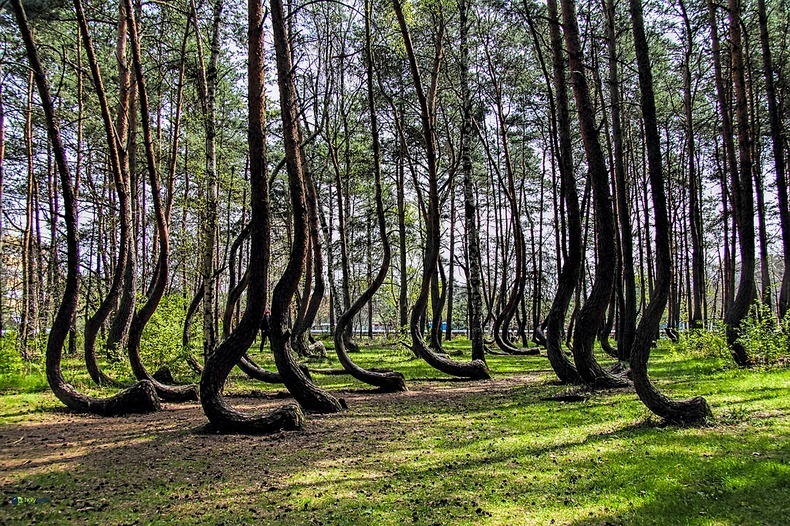
The Crooked Forest consists of approximately 400 pine trees, each curving dramatically at the base before straightening upwards. The trees form a near-uniform J-shape, with the bends consistently facing north. This peculiar shape has fascinated botanists, historians, and visitors for decades, as its origin remains uncertain.

If you look at the base of these trees, you might feel like you’ve just entered a strange mystical fairy tale. All of the trees have the same northward 90-degree bend at the base of their limb. Known as the “Crooked Forest,” this unique site remains an unexplained mystery. Every tree in the Crooked Forest has the same haunting bend, but despite bent beginnings, all of the trees have grown to be tall and seemingly unhampered by their C shape curves. Some experts believe that the trees grew like this because they incurred some sort of damage to the tip and along some side branches.Trees are resilient, and so they continued to thrive, relying on the one branch they had left to take over complete function and grow upwards. Whatever damage occurred to one tree must have happened to them all because they remain uniform in deformity.

Theories Behind the Mystery:

Several theories attempt to explain the strange formation of the trees. Some of the most prominent include:

  • Human Intervention: Many believe that the trees were deliberately manipulated by local foresters in the 1930s. The theory suggests that young trees were bent for use in shipbuilding, furniture-making, or construction, but due to World War II, the project was abandoned, leaving the trees to continue their unnatural growth.
  • Gravitational Anomaly: Some speculate that the forest is located in a unique gravitational field that influenced the trees' growth. However, no scientific evidence supports this claim, making it more of a local legend than a plausible explanation.
  • Heavy Snowfall: Another possibility is that heavy snowfalls in the early years of the trees' growth forced them into their curved shape. However, this theory does not explain why the trees all bent in the same direction. 
  • Genetic Mutation: Some researchers suggest that the phenomenon could be due to a genetic mutation, though this theory lacks substantial evidence and does not account for the uniformity of the bends. 
The possibilities are truly endless when it comes to this unsolved mystery. There are plenty of trees in the area, all of which grow upright from the base without the funky curve distinct to the Crooked Forest clan. The Crooked Forest is an odd occurrence in a seemingly ordinary place. So perhaps you are wondering why none of the locals have answers to what caused the formation of the Crooked Forest.
 
Crooked Forest

A Tourist Attraction Like No Other:

Despite its mysterious origins, the Crooked Forest has become a major tourist attraction. Visitors from all over the world come to marvel at the eerie yet beautiful sight. The surrounding area offers picturesque landscapes, making it a great destination for nature lovers and photographers.

 look at the forest and you start to imagine endless possibilities, so much history packed into the roots of these trees-if only trees could talk!

Preservation and Future:

The Crooked Forest is around 80 years old. It is estimated that the damage that made them look how they do today occurred when the trees were about 7 years old. This would have been before the Second World War reached Poland. Which helps to explain the most popular theory about how the trees came to be crooked. As the story goes, in 1930 a group of farmers planted these trees, intentionally damaging the base in order to create some sort of product, perhaps uniquely shaped furniture. The world may never know if it’s true because the farmers were unable to finish their work after the invasion on Poland during World War II dismantled their plans.It is likely the trees were formed like this to make furniture, ship mantels, or numerous other woodworking projects. After all it’s not unheard of to grow trees with a curve in the branch for certain wood-made parts. This practice produces what is known as “compass timbers.”

Efforts have been made to preserve the Crooked Forest as a natural heritage site. Since it remains a unique phenomenon with no definitive explanation, conservationists are keen to protect it from deforestation, pollution, and excessive tourism impact.

Conclusion:

The Crooked Forest remains one of nature’s greatest puzzles, its twisted trees standing as silent witnesses to a history that may never be fully understood. Whether shaped by human hands, environmental forces, or something even more mysterious, this enchanting grove in Poland continues to capture the imagination of all who visit.

Crooked Forest

Mount Roraima (Hike to the top of the “Lost World”), South America

Mount Roraima is the highest of the Pakaraima chain of tepui plateaus in South America. First described by the English explorer Sir Walter Raleigh during his 1595 expedition, its 31-square-kilometre (12-square-mile) summit area is bounded on all sides by cliffs rising 400 metres (1,300 ft). The mountain also serves as the tripoint of Venezuela, Guyana and Brazil. Mount Roraima lies on the Guiana Shield in the southeastern corner of Venezuela's 30,000-square-kilometre (12,000-square-mile) Canaima National Park forming the highest peak of Guyana's Highland Range.

The highest point in Guyana and the highest point of the Brazilian state of Roraima lie on the plateau, but Venezuela and Brazil have higher mountains elsewhere. The triple border point is at 5°12′08″N 60°44′07″W, but the mountain's highest point is Laberintos del Norte. 
 
Many of the species found on Roraima are unique to the tepui plateaus with two local endemic plants found on Roraima summit. Plants such as pitcher plants, Campanula , and the rare Rapatea heather are commonly found on the escarpment and summit. It rains almost every day of the year. Almost the entire surface of the summit is bare sandstone, with only a few bushes and algae present. Low scanty and bristling vegetation is also found in the small, sandy marshes that intersperse the rocky summit. Most of the nutrients that are present in the soil are washed away by torrents that cascade over the edge, forming some of the highest waterfalls in the world.

There are multiple examples of unique fauna atop Mount Roraima. Oreophrynella quelchii, commonly called the Roraima Bush Toad, is a diurnal toad usually found on open rock surfaces and shrubland. It is a species of toad in the family Bufonidae and breeds by direct development. The species is currently listed as vulnerable and there is a need for increased education among tourists to make them aware of the importance of not handling these animals in the wild. Close population monitoring is also required, particularly since this species is known only from a single location. The species is protected in Monumento Natural Los Tepuyes in Venezuela, and Parque Nacional Monte Roraima in Brazil


Although the steep sides of the plateau make it difficult to access, it was the first recorded major tepui to be climbed: Sir Everard im Thurn walked up a forested ramp in December 1884 to scale the plateau. This is the same route hikers take today. A report by the noted South American researcher Robert Schomburgk inspired the Scottish author Arthur Conan Doyle to write his novel The Lost World about the discovery of a living prehistoric world full of dinosaurs and other primordial creatures.

The only non-technical route to the top is the Paraitepui route from Venezuela; any other approach will involve climbing gear. Mount Roraima has been climbed on a few occasions from the Guyana and Brazil sides, but as the mountain is entirely bordered on both these sides by enormous sheer cliffs that include high overhanging (negative-inclination) stretches, these are extremely difficult and technical rock climbing routes. Such climbs would also require difficult authorizations for entering restricted-access national parks in the respective countries.In Brazil the Monte Roraima National Park lies within the Raposa Serra do Sol Indigenous Territory, and is not open to the public without permission.

The 2013 Austrian documentary Jäger des Augenblicks - Ein Abenteuer am Mount Roraima (Moment Hunters - An Adventure on Mount Roraima) shows rock climbers Kurt Albert, Holger Heuber, and Stefan Glowacz climbing to the top of Mount Roraima from the Guyana side. Similarly, in 2010 Brazilian climbers Eliseu Frechou, Fernando Leal and Márcio Bruno opened a new route on the Guyanese side, climbing to the top in 12 days of a very difficult vertical wall climb.

Jul 22, 2018

Rainbow River or Caño Cristales (Color of Nature), Serrania de la Macarena, Colombia

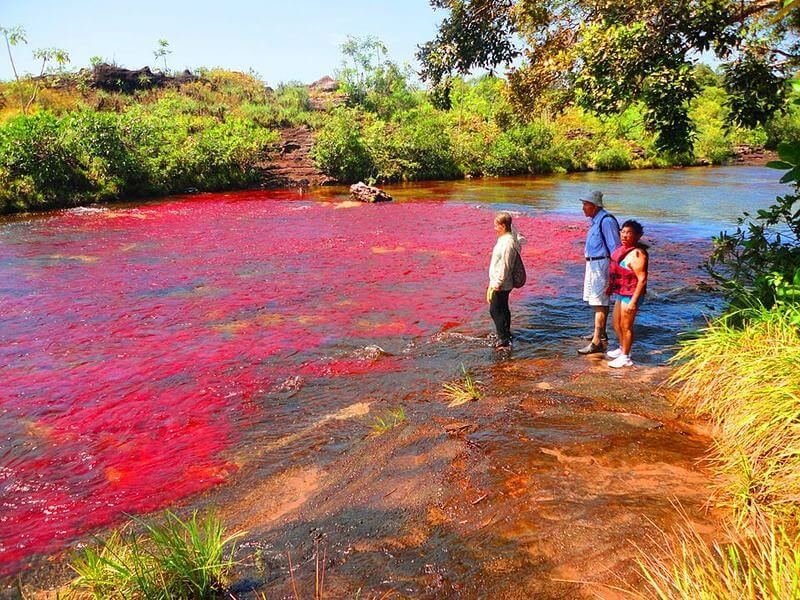
Rainbov River or Caño Cristales is a Colombian river located in the Serrania de la Macarena province of Meta. It's a tributary of the Guayabero River. The river is commonly called the "River of Five Colors" or the "Liquid Rainbow," and is even referred to as the most beautiful river in the world due to its striking colors. The bed of the river from the end of July through November is variously colored yellow, green, blue, black, and especially red, the last caused by Macarenia clavigera plants (family Podostemaceae) on the bottom of the river.


The quartzite rocks of the Serrania de la Macarena tableland formed approximately 1.2 billion years ago. They are a western extension of the Guiana Shield of Venezuela.

Caño Cristales is a fast river with many rapids and waterfalls. Often in the bed have formed small circular pits - giant's kettles, which have been formed by pebbles or chunks of harder rocks. Once one of these harder rock fragments falls into one of the cavities, it is rotated by the water current and begins to carve at the cavity wall and increases the dimensions of the pit

The Serranía de la Macarena is located on the border of three large ecosystems, each of them with high diversity of flora and fauna: the Andes, the Eastern Llanos, and the Amazon rain-forest. Plant and animal life are struggling with the lack of nutrients on the solid rock surface of the tableland and have developed diverse adaptations. The representative biome of the Serranía de La Macarena is the hydrophytic rainforest: hot, warm, and cold. The tableland is home to about 420 species of birds, 10 species of amphibians, 43 species of reptiles, and 69 primates.

Caño Cristales river has a wide variety of aquatic plants. The water of the river is extremely clear due to the lack of nutrients and small particles. Almost unique is the bright red - pink coloration of riverbed after the rainy period in the end of July - November. This color is caused by great quantities of endemic plant species Macarenia clavígera. This plant is found in some more local rivers, such as the Caño Siete Machos. These red plants adhere tightly to rocks in places where the river has faster current.

Sep 19, 2017

Gardens by the Bay: A Futuristic Oasis in the Heart of Singapore

Gardens by the Bay is a nature park spanning 101 hectares (250 acres) of reclaimed land in central Singapore, adjacent to the Marina Reservoir. The park consists of three waterfront gardens: Bay South Garden, Bay East Garden and Bay Central Garden. The largest of the gardens is Bay South Garden at 54 hectares (130 acres).

Gardens by the Bay is part of a strategy by the Singapore government to transform Singapore from a "Garden City" to a "City in a Garden". The stated aim is to raise the quality of life by enhancing greenery and flora in the city. 
 
First announced by the Prime Minister, Lee Hsien Loong, at the National Day Rally in 2005, Gardens by the Bay was intended to be Singapore's premier urban outdoor recreation space, and a national icon. 
 
Gardens by the Bay
 
In 2006, an international competition for the design of the park was held, attracting more than 70 entries submitted by 170 firms from 24 countries. Two British firms – Grant Associates and Dominic White were awarded the contracts for the Bay South and Bay East Gardens respectively.

Alongside the lead designers Grant Associates, the design team for Bay South included Wilkinson Eyre, Atelier Ten (environmental design consultants) and Atelier One (structural engineers). They were supported by a number of Singapore firms including CPG Consultants (architecture, civil and structural, mechanical and electrical), Meinhardt Infrastructure (civil and structural), Langdon & Seah (cost consultants) and PM Link (project management). The park is quite popular, with 6.4 million visitors in 2014, and it had its 20 millionth visitor in November 2015. 
 

Bay Central Garden will act as a link between Bay  South and Bay  East  Gardens. It  stands at  15  hectares (37 acres) with a 3-kilometre (1.9 mi) waterfront promenade  that  allows  for scenic  walks stretching  from the city center to the east of Singapore. More developments of  Bay  Central  Garden  are coming in the next few years.

Bay East Garden

Bay East Garden is 32 hectares (79 acres) in size and it has a 2-kilometre (1.2 mi) promenade frontage bordering the Marina Reservoir. An interim park was developed at Bay East Garden in support of the 2010 Summer Youth Olympics. The first phase of the garden was opened to the public in October 2011, allowing alternative access to the Marina Barrage.
 
It is designed as a series of large tropical leaf-shaped gardens, each with its own specific landscaping design, character and theme. There will be five water inlets aligned with the prevailing wind direction, maximizing and extending the shoreline while allowing wind and water to penetrate the site to help cool areas of activity around them. Bay East Garden provides visitors with an unobstructed view of the city skyline. Upcoming developments of Bay East Garden will be based on the theme of water.

Bay South Garden

Bay South Garden opened to the public on 29 June 2012. It is the largest of the three gardens at 54 hectares (130 acres) and aims to showcase the best of tropical horticulture and garden artistry.
 
Gardens by the Bay

The overall concept of its master plan draws inspiration from an orchid as it is representative of the tropics and of Singapore, being the country's national flower, the Vanda 'Miss Joaquim'. The orchid takes root at the waterfront (conservatories), while the leaves (land forms), shoots (paths, roads and link ways) and secondary roots (water, energy and communication lines) then form an integrated network with blooms (theme gardens and Super trees) at key intersections.

Gardens By The Bay Attractions:

  • Flower Dome - Enter a world of perpetual spring, where unique plants bloom. 
  • Cloud Forest - Step into a realm high in the mountains. 
  • OCBC Skyway -Take a scenic stroll, 22 metres above ground, in the very heart of nature. 
  • Super tree Grove - Stand in awe of the amazing Supertrees. 
  • Far East Organization Children's Garden -Explore the sights and sounds of nature’s playground. 
  • Bay East Garden -Welcome to a world of serenity at bay east by the waterfront. 
  • Dragonfly & Kingfisher Lakes -Immerse in the fascinating aquatic ecosystem. 
  • Heritage Gardens - Bringing the history of singapore to life through the fascinating story of plants. 
  • World of Plants - Explore a beautiful botanical world that’s intriguing and always full of surprises. 
  • The Canyon - Come marvel at rocks of wonder at The Canyon. 
  • Sun Pavilion - Be transported to some of the world’s most dynamic drylands and deserts. 
  • Art Sculptures -Connecting people with the stories of plants and the world at large.
For More  Gardens By The Bay 

 
Tips for Visitors 
  • Best time to visit: Late afternoon to enjoy daylight views and stay for the Garden Rhapsody night show.

  • Don’t miss: OCBC Skyway, Cloud Forest waterfall, and seasonal Flower Dome exhibits.

  • Perfect for: Families, couples, photographers, nature lovers, architecture enthusiasts.

  • Bring: A camera, comfortable shoes, and a light jacket for the cool conservatories.

A Destination Like No Other

Gardens by the Bay is more than just a garden. It’s an immersive blend of technology, creativity, and nature. Whether you’re wandering through misty mountain jungles, admiring glowing trees against the night sky, or exploring global ecosystems under glass domes, the park invites you to see the world with fresh eyes.

If you’re visiting Singapore, this extraordinary garden is simply unmissable